Holiday Lights

What holiday traditions does your family have?

We have a handful of holiday traditions we try to do each year (weather tends to dictate). We go to a botanical garden that is decorated with lights — animals, plants, sea and even mystical creatures. It’s a 20-minute walk to see it all, but something we enjoy. We like checking out lights around different neighborhoods — with one, in particular, that goes all out (dozens and dozens of homes decorated from top to bottom). We go to a nearby lake trail that does luminaries the second Saturday of each December.

I love these traditions, and they are all different from traditions I did growing up — when opening an Advent Calendar door was a thrill (one day closer to Christmas!), watching Rudolph the only night and time it aired (VCRs weren’t around yet), and baking up more goodies than we could possibly eat.

My sons love our traditions (or, at least, I think they do). They will remind us (if we haven’t mentioned already having plans), to keep us on track and the traditions alive. It’s fun to see my oldest get excited about spending time with us (his family) for anything. 😊 And seeing the boys together — joking around, enjoying each other, and the sights with their father and I is their gift to me each year (mostly figuratively, but sometimes literally too #averyMomChristmas 😂🥰).

What holiday traditions do you have? What gift does your child give you?

Soar like an Eagle

When last did you see your child soar?

My oldest, surprisingly to his father and I, decided to go for his Eagle Scout rank (Boys Scouts of America). My husband had earned his, and something about scouts appealed to my son. My husband took him to his first meeting years ago and thought our son would attend maybe one or two meetings and call it quits, but he didn’t. The skills and life lessons were what seemed to appeal to him.

I’d like to say my husband and I had a handle on how best to teach our boys all the life lessons we wanted to pass on, but we were wrong. Scouts gained our child’s interest in learning skills in a way that wouldn’t have occurred by mom and dad trying to educate (lecture?) them. I can see my son’s eyes rolling if we’d taken this approach. Instead, getting merit badges with counselors who held him accountable with what was needed and timelines to complete motivated our son. He was eager to learn and demonstrate proficiency. A favorite memory was talking to him and his brother in a car trip through Yellowstone National Park. There were long periods of time in the car. We talked about finances — saving for retirement, a house. Rent vs buying, the pros and cons, and what goes into each and more. He and his brother were very interested in learning and asked great questions. My husband and I were aware of how special that discussion was.

Scouting gave him leadership opportunities, a requirement to move up, that he took, learned and benefited from. His life skills continuing to grow. After completing the required merit badges and leadership position he needed to complete his Eagle Scout project which I previously blogged about. It was a steep learning curve for my son, but he completed the task.

The last requirement was going in front of a board to demonstrate proficiency and assess what had been learned and gained from the scout’s experience. My son prepared and wanted to do his best. Helping him get ready was another opportunity for my husband and I to teach him another valuable life skill — interviewing and being prepared (part of the Scout Motto) for unexpected questions he might get asked.

The review was done via video. My husband and I sat in another room anxiously awaiting to hear from our son and how the review went. He came out and was disappointed in how he did. You could see the stress in his face — did he just blow his chance for Eagle rank by how he’d answered the questions? While my son was stressed, my husband and I were not. The board review was more of a formality and unless he behaved out of character (being rude or disrespectful) the rank would be awarded. “They want to talk to you here in a few minutes.” We attempted to comfort him, but he convinced himself that bad news was coming. As we thought, the Scout leaders called us in and shared our son had earned his Eagle rank and we should be very proud. We were. I felt a combination of pride, relief, along with a smidge of sadness. Pride in our son seeing this through. Relief in that this was behind him and he no longer needed to worry about requirements and timelines. Sad in our son no longer having the prompt of earning a merit badge to engage with him and teach him a life skill.

He has the skills Scouts gave him to soar. I look forward to seeing him take flight.

What are skills you want to impart on your child? How are you helping them succeed (take flight)?

The Attitude of Gratitude

Being grateful for the gifts in life is a daily practice for our family.

At dinner, we pray before eating focusing, most often, on what we are grateful for — the sun being out, doing better on a test than we thought we would, having a work project completed, our cat being cute and doing cute things (almost always included by my youngest). We sometimes get more serious and talk about the basics that we are thankful for—food to eat, a warm place to stay, our loved ones, our health, and the health of loved ones. The basics are what we are most grateful for. It’s hard to imagine (bear the thought) of those without. Never wanting to take the basics for granted or helping those without when we can.

There is much to be concerned about in the world, that can feel overwhelming (How can we help? What will it take to stop others suffering from war, abuse, or lack of resources?). If we’re not careful we can lose sight of the good things happening around us.

My husband works weekly with a program that serves hot meals to an often neglected part of the community. The guests may have mental health struggles, addiction, homelessness, or a combination of these things and more. He enlisted our sons to help when they were in middle school, having them join him periodically to help dish up, or serve/hand-out the meals. I join them, as well, from time to time.

The boys have learned a few things by doing this—there are a lot of good people out there (despite our political views, socioeconomic status, or education level), we are more alike than different; we all want the same basics—food, shelter, and connection; and what brings us together is an attitude of gratitude. Those cooking and serving want to help ease the suffering of others, or, at least, provide respite for a few hours. Those that receive are allowing themselves to be vulnerable to this community with the hopes of filling their often empty stomachs, and feeling warmth (literally and figuratively) and connection from those welcoming them in. It is a two-way street of gratitude.

What are you and your family thankful for?

I’ll be off for the Thanksgiving holiday and back in December.

Model Building

What is your kid enthusiastic about?

When my youngest was small (ages 3-8), he was obsessed with Cars (yes, capitalized, because I’m referring to the Pixar movie). 🥰 He developed a love of (lower case) cars as a result of the film (the best my husband and I can tell). This love of cars went up through his early teens. I can remember the countless hours of him playing with matchbox-sized cars (many in the form of Cars characters), lining them up, creating storylines, and making his own story with them coming to life (stop motion app, using mom or dad’s phone).

He’s older now and his tastes have changed. Cars (upper or lower case) no longer hold his attention. His loves have changed: geography, maps of the world, to trains, and then subway/transit systems. He is so interested (remember being on the spectrum, a super power is having clarity about your passion), he is participating in community board on transit for teens, various community events (openings, trivia nights, etc.), and wants to go into this field (city planning, transit advisor) as a career.

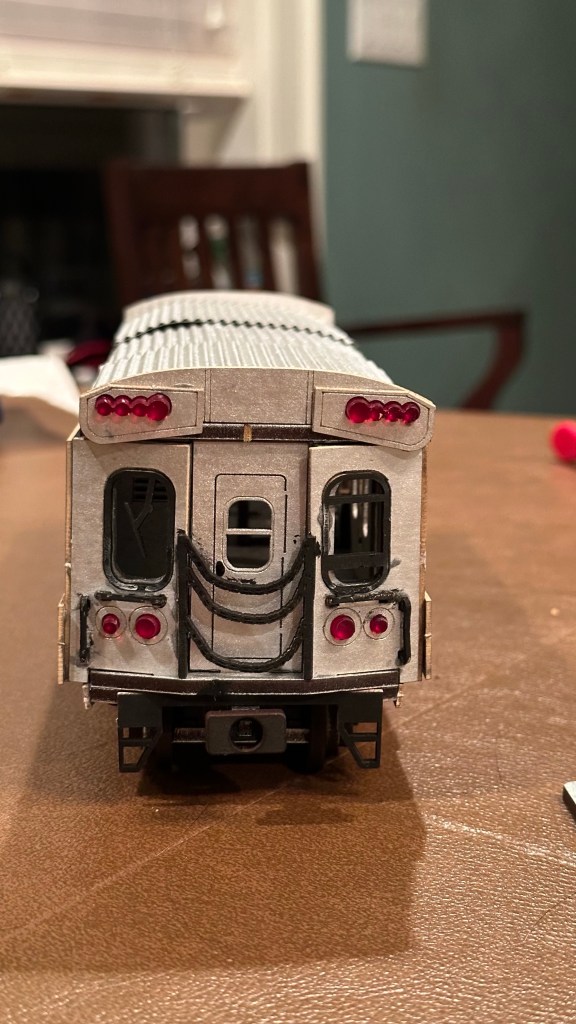
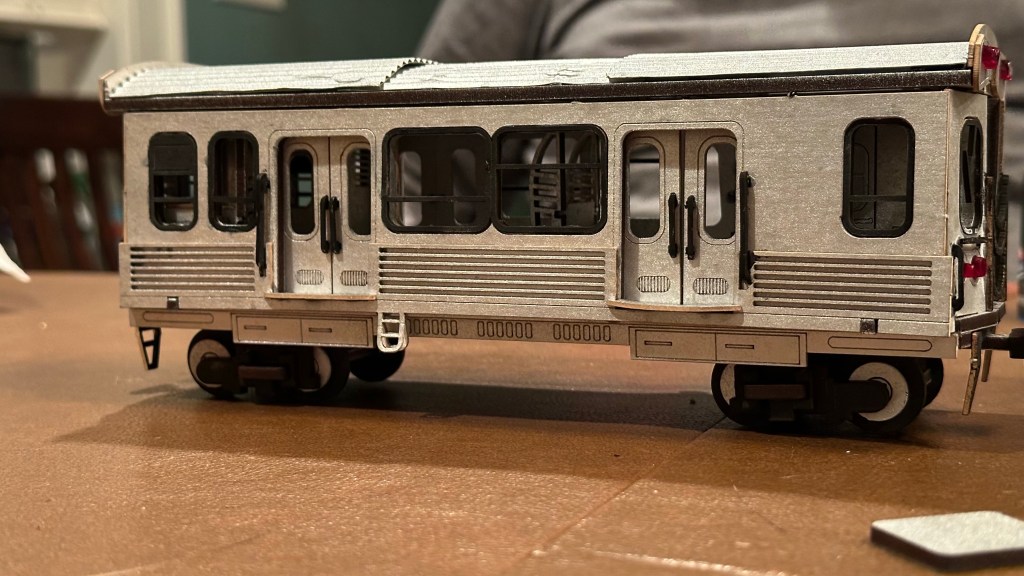
He has started collecting model subway cars to add to his already vast transit map collection. For his birthday, he asked for more models. He has traditionally wanted only completed models, but we thought we’d get him a kit and see if he’d enjoy building one. My husband has built model kits before (planes), so our sons have seen some of the joy this brings to their dad.

When our son opened the kit, we thought our chances were 50-50 that he’d want to build it, vs. having us send it back. I asked him if he’d like to work on it together and he said, “I’d like to work on this with dad because he’s done these things before.” I smiled—partially because he wanted to build it, and two, he wanted my husband’s help and not mine (I’m sure I could have helped him, but not sure I would have been the best partner). 😊

He and my husband set out working on the model subway car each night. Watching them work together on the build was something. There was excitement (for the model taking form), stress (oh no, we threw out the roof think it was trash, go check the recycling!), relief (thank goodness it wasn’t recycle pick-up week), and quiet love as they worked on the model figuring it out piece by piece. This model build may be the most special one for my son (and husband), since they built it together.

What have you and your child done together that’s been special and/or brought you closer?

Who Are You?

Have you ever wondered what your child is thinking? How they see themselves? How they think others see them?

My youngest is willing to engage without much effort and comfortable sharing who he is with his father and I, and others. My oldest is more of a closed book—engaging infrequently and sharing bits and pieces that make it hard(er) to figure the complete picture out.

My oldest engages as he’s ready, late at night when my husband is getting ready for bed, in the car when I pick him up from practice, or what my husband and I feel are “out-of-the-blue” moments. My son recently asking his father if he wanted to go for a run with him. My husband had to suppress his excitement—and surprise at my son’s request (it’s that meaningful to us when he opens up to us and shares, well, anything).

His football team has had a good year and are now in the playoffs. He helps manage the team and does film review with the coaches. He seems more comfortable than I’ve seen him in a while. Before the most recent game, the officials were down on the field before the game started. My son, who also referees flag football games, seemed to know at least one of the officials through his other job. They shook hands, talked, laughed, and then the other officials came over. I saw my son talk easily and shake hands with the others. It was impressive to watch. If you didn’t know better, you would have thought my son was in a higher leadership position, such as the head coach. The moment gave me pause. “Who is this kid?” The confident young man on the field looked like my son, but wasn’t acting like the kid I know. I wondered what else I didn’t/don’t know about him.

As a parent, I long to know my children deeply. I want to know who they are, what motivates them, makes them happy, and what will help them thrive. I also want to know their father and I are doing right by them, and helping prepare them to navigate life so it’s meaningful and joyful, and ensure they have the tools to navigate tough times and situations and know they’ll make it through and be okay. Yet, I’m in the stands of the game wondering who my son is, how I can know him better, and make sure I’ve done my job.

I’m not sure if we ever truly know this as parents, which will have me always working towards knowing my children better.

How do you see your child? How have they shared who they are (or are becoming) with you?

Pumpkin Patch

Cool crisp air, leaves changing colors, apple cider. It’s definitely a favorite time of year for our family.

We went to a pumpkin patch that’s become a tradition for us. We arrive, take in surrounding area that has different decorative pumpkin, squash, and gourd displays; check out what the local vendors are offering, get a wheelbarrow and head out towards the fields to get our pumpkins. Once we have our pumpkins we typically head out to get a meal nearby before heading home. I take LOTS of pictures each time we go — trying to remember it all. 😊 My oldest reminded us that since this would be his last year doing this with us (gulp), he’d get to pick where we ate lunch following. 😂

The pumpkin patch looked different than previous years — fields had been rotated, the corn maze was gone (as the corn, in the new field, was only three feet tall), but it didn’t matter because we were there together. Making our way through the fields to find our pumpkins, enjoying cider, and just being with each other.

It wasn’t anything special per se, but was special because of the tradition and memories and the wonderful feelings that come with it.

I do love this time of year.

What Fall traditions does your family have?

It’s Going to Be Okay

‘It’s going to be okay’ is a phrase that has gotten me through many a difficult situation. Hearing from my parent, when I was young, or my husband now, has always given me comfort.

My oldest had a test that was stressing him out. He was struggling with some of the concepts being taught and was concerned he wouldn’t do well on the test. We talked about what he could do to prepare in advance. That helped ease his anxiety slightly but it was still there. He took the test, and the teacher had the students take pictures of their work which they emailed in. It was an additional step to handing in the test to a proctor. My son came home. He was relieved that the test had gone much better than expected, but stressed because he realized in his desire to leave the testing area as soon as possible after turning in the test, he realized he hadn’t gotten clear pictures of all of his work. “Mom, the pages that didn’t come through equal 20% of my grade.” He sat down, put his head in his hands and said, “how will I ever be able to live on my own?” That statement caught my attention. I can understand being stressed about a mistake you’ve made that might result in something negative happening to you (such as getting a poor grade), but thought him extrapolating this to not being able to go out on his own an extreme thought.

We talked about the situation at hand first. I asked him what he could do to rectify the situation. He shared he’d already emailed the teacher and we discussed him going back to the test site to see if the proctor would allow him to retake the pictures of his work (he went back, but the proctor wouldn’t allow him access to his test). I then shared my own experience and how sometimes in life I catch myself wanting to leave a situation (for discomfort, I want to get to the next thing, or a variety of other reasons) and I can make mistakes in those situations. I asked my son, “how am I able to keep going if I know I might do this? I’ve lived on my own for a while and I’ve never been concerned in my ability to successfully do that. Why is that?” I smiled and he did too. It didn’t take him long to come back with the correct answer, “you learned from your mistake.” I told him that he was right and shared that even though I still “do things fast” on occasion, I do them less frequently than when I was younger and I try to catch myself in the moment and tell myself to “slowdown”. I finished by telling him that no matter the outcome of the test everything was going to be okay. I told him, “it might not feel like it now, but I promise you everything will be okay.” A poor grade can be overcome with improved work and extra credit (assuming the teacher allows). Absolute worst case is he fails the class and has to take it over. While the scenarios might not seem fun, they were all something that could be addressed. Not long after we finished our conversation my son shared that he’d heard from his teacher who told him not to worry about it, he was more concerned with the work being shown on the test, than the actual pictures coming through and being clear. It had indeed ended up being okay.

How do you help your child work through a mistake they’ve made? How do you let them know things will work out or be okay?

Chrysalis

At what age did you emerge from your childhood cocoon?

My oldest is a senior and thinking about where life will take him next. He’s starting to get a taste of having more freedom and understanding that he ultimately controls where and what he does next. While he’s still living at home, he has a safe, protected, and supportive environment to make mistakes and learn from them.

As I think about his upbringing I can see clear lines between him as a small child and the adult he is becoming. Then there is this gray period inbetween the two where he is leaving one phase of life and preparing for another. In this “cocoon”-phase he could be distant, and hard to understand, but you knew what was inside him needed to be protected and nourished and so you let the cocoon be — not leaving it alone, but understanding (or trying to) how growing up can be hard and scary sometimes. It can also be joyful and comforting, and so much more.

It feels like my oldest is starting to emerge from his cocoon with a more open disposition. He’s more likely to talk, engage, and is in general happier. Is it because he’s understanding he will figure out his next stage of life? He’s appreciating the love and support while making the transition? Or something else?

Only he knows, but it’s amazing to see this new phase and him taking flight.

What phase of life is your child in? How are you helping them transition from one phase to another?

Figuring Out Friendship

Have you ever parted ways with a friend?

Parting has been easiest, for me, when our locations and situations took us different places and nothing was explicitly said. The door open to reconnect or resume the friendship is there should the opportunity arise. It’s hardest when betrayal or some type of perceived hurt has occurred — coming back from it might not be possible. Then there is everything in between.

My youngest in high school has reconnected with an elementary classmate, and together brought a third, newcomer, into their group. My son enjoyed getting to know his new friend, even walking home from school a few times together, until he didn’t. He started seeing differences between he and this new person which made him take an inventory for what he wants in a friendship. This new friend appreciates women based on looks more than anything else, and likes watching/listening to crude humor on his phone. I can’t say this is untypical of any teen, but what struck me was how off putting it was to my son. My son shared his friend had been vulnerable with him, and he was in turn, but then the friend started teasing him about what he opened up about, making him regret sharing at all. The final ‘blow’ was when the friend kept trying to get my son to engage with him during lunch period, and my son wanted no part. My son shared, “I don’t think I want you to be friends with him anymore.”

I’ve often felt my son wanted more friends, but what held him back was some challenges he faced by being on the spectrum (such as missing social cues), what I found was my son having clarity in what he wants in friendship and not being willing to settle.

We talked about the differences between he and his friend, with the main one being my son had had the good fortune of having teachers, and caregivers that modeled healthy relationships and strong emotional intelligence — give him tons of tools for his toolkit. His friend, hadn’t had these same resources and may not have the knowledge my son has. The comparison I made was my son have a full tool belt, uniform, and protective gear, and his friend being naked. I shared this with my son, so he would have empathy for his friend. He could either help his friend grow with his knowledge or part ways because the effort wasn’t worth it or the friend wouldn’t be open to it. My son took it under advisement and decided he wouldn’t proactively engage this friend, but wouldn’t outright tell him the friendship is over either. So far it’s worked out. Neither boy has really engaged the other and the loss of a friendship doesn’t seem to bother my son (or the other boy, best we can tell), at all.

Ending a friendship is never easy. Making a new friend isn’t easy either. How are you helping your child navigate friendship?