Neighborhood (Pet) Watch

What are you on the lookout for in your neighborhood?

We take evening walks when the weather is nice in our neighborhood. A favorite pastime during these walks is to find neighborhood cats. Finding a new one is even better.

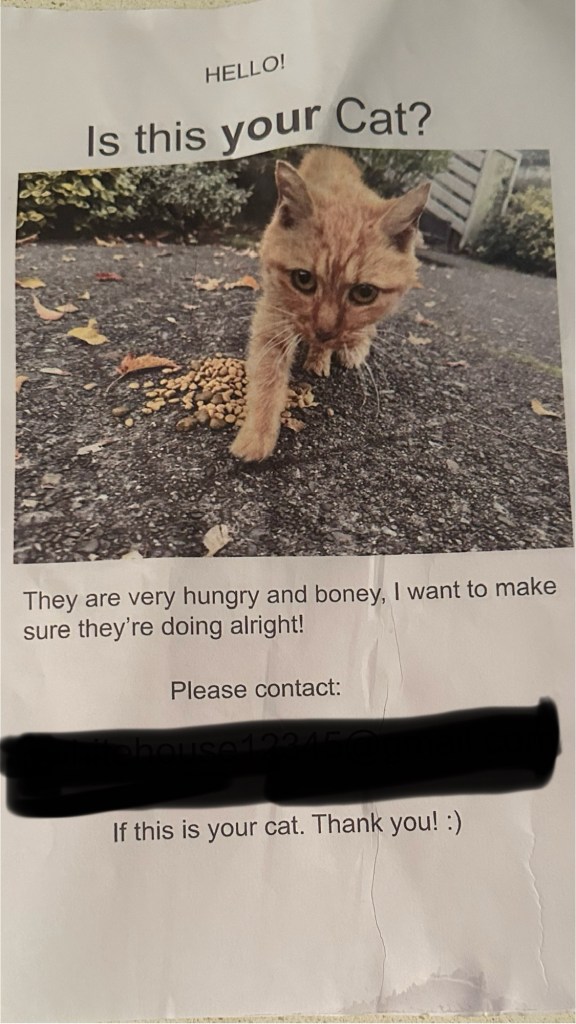
My husband texted me during a walk he and my son were on, and asked if I’d prepare a bag of cat food for him. They had found a new cat that was skin and bones and they wanted to feed it. They did, and came back sharing news about the cat they found and the concern it had a home. My youngest made it his mission each day after to go back to that part of the neighborhood to find the cat again. While it had a flea collar on (indicating it had a pet parent), its size had us concerned. Maybe the pet parent had fallen ill, or could no longer afford to feed the animal.

My son turned detective and became relentless at solving the case. If the cat had owners, they needed to take better care of the cat. If the cat was lost, he wanted to reunite it with it’s pet parent (though I have a sneaking suspicion he would have been okay if no parents could be located and he could adopt the cat). 🥰 He knocked on doors (no one answered). He talked to a nearby neighbor out in their yard. He even called the local vet and animal rescue to get advice from them on what he should do. It was a growing experience for him. Engaging with neighbors in this way, and making phone calls to inquire about the animal were new to him.

At the encouragement of his father he made a sign to hang in the neighborhood near where he’d seen the cat.

Sign for Neighborhood Cat

I didn’t see the poster before he left the house armed with food, water, bowls, the poster and a stapler. He was going to make sure this cat was cared for. I did see it once he was back, reporting the cat did have a pet parent, and he saw the cat eating from a bowl outside. You could tell it was bittersweet for him — happy the cat was being cared for after all, but sad he couldn’t be the one to do it.

I suspect we’ll continue our walks and check in on this cat each time we’re out (for the foreseeable future). It’s good to keep an eye on those that are vulnerable and do whatever it takes to get them help. I’m proud of my son for his commitment to this cat’s well-being.

What do you keep an eye out for in your neighborhood?

Weathering the Storm

Watching the destructive weather that has hit the southeast these past few weeks has been hard to take it. On one hand, you’re grateful you’re not in the path of the destruction, but scared, sad, and empathetic to those experiencing it, particularly when many of the people are family and friends (or remind you of your family and friends).

There wasn’t much we could do as Milton barreled towards Tampa. We had family recouping from major surgery (that couldn’t evacuate) in the area, and many loved ones scattered north, south, and east. No one seemed to be truly safe. Throw in the tornadoes that occurred relatively ‘far’ away from the center of the storm, high winds, and storm surge, and taking it all in from afar felt almost unbearable.

There were calls, and texts, before and after the storm. Grateful when you learned someone was safe, nerves when you haven’t. After I had reached out to immediate family, my youngest asked who else I’d checked on. “Mom, we have to make sure everyone is okay.” I appreciated his genuine concern, and him reminding me to continue reaching out, even though electricity, connectivity, and accessibility (coming to and from where you have access to these things), are not available for many and likely won’t be for some time. Waiting to hear is hard.

I think about those that have lost their home, or possessions, or a loved one. I think about schools being closed, how these traumatic events affect adults and children — it changes you. Seeing everyone pitching in regardless their socioeconomic status, or political leaning, or religious affiliation, come together to help on another, makes me hopeful for how we weather these storms. Community — us coming together—is your family during these times.

What storms (literal or figurative) have you and your family weathered?

Figuring Out Friendship

Have you ever parted ways with a friend?

Parting has been easiest, for me, when our locations and situations took us different places and nothing was explicitly said. The door open to reconnect or resume the friendship is there should the opportunity arise. It’s hardest when betrayal or some type of perceived hurt has occurred — coming back from it might not be possible. Then there is everything in between.

My youngest in high school has reconnected with an elementary classmate, and together brought a third, newcomer, into their group. My son enjoyed getting to know his new friend, even walking home from school a few times together, until he didn’t. He started seeing differences between he and this new person which made him take an inventory for what he wants in a friendship. This new friend appreciates women based on looks more than anything else, and likes watching/listening to crude humor on his phone. I can’t say this is untypical of any teen, but what struck me was how off putting it was to my son. My son shared his friend had been vulnerable with him, and he was in turn, but then the friend started teasing him about what he opened up about, making him regret sharing at all. The final ‘blow’ was when the friend kept trying to get my son to engage with him during lunch period, and my son wanted no part. My son shared, “I don’t think I want you to be friends with him anymore.”

I’ve often felt my son wanted more friends, but what held him back was some challenges he faced by being on the spectrum (such as missing social cues), what I found was my son having clarity in what he wants in friendship and not being willing to settle.

We talked about the differences between he and his friend, with the main one being my son had had the good fortune of having teachers, and caregivers that modeled healthy relationships and strong emotional intelligence — give him tons of tools for his toolkit. His friend, hadn’t had these same resources and may not have the knowledge my son has. The comparison I made was my son have a full tool belt, uniform, and protective gear, and his friend being naked. I shared this with my son, so he would have empathy for his friend. He could either help his friend grow with his knowledge or part ways because the effort wasn’t worth it or the friend wouldn’t be open to it. My son took it under advisement and decided he wouldn’t proactively engage this friend, but wouldn’t outright tell him the friendship is over either. So far it’s worked out. Neither boy has really engaged the other and the loss of a friendship doesn’t seem to bother my son (or the other boy, best we can tell), at all.

Ending a friendship is never easy. Making a new friend isn’t easy either. How are you helping your child navigate friendship?

Head and Heart

How does your child show others who they are?

My family and I were fortune to see Peggy Orenstein talk about her book Boys & Sex: Young Men on Hookups, Love, Porn, Consent, and Navigating the New Masculinity. My husband and I decided to have our sons attend with us. While the idea of having to hear about sex, intimacy, and porn with my kids made me uncomfortable, my husband and I knew if these topics were ‘out in the open’ we could talk more openly with our kids about what they are seeing, hearing, and thinking.

My kids shared my discomfort. “Mom, do we have to go?,” they asked. There was no getting out of it. If I as going to power through my discomfort so we’re they. We were going to this talk as a family. I did suggest a compromise, “I know you’re uncomfortable being with mom and dad at this event. If you want to sit away from us, that’s okay.” That seemed to make us all feel a little better.

One of the most powerful revelations I had during Peggy’s talk was when she shared what her work uncovered — that girls are taught to disconnect from their bodies (who you are is one thing, your body or outward appearance another), and boys are taught to disconnect from their heart (have feelings, empathy, etc., but not be able to show them). I thought about how I’ve seen my oldest son struggle with this. It’s like the empathetic kid I’ve known has been working hard to stuff his feelings and empathy way down–with it rarely surfacing as he ages. My husband and I have talked to him about toxic masculinity and encouraged him not to buy into it (or fall into its trap), but Peggy shared insights that helped outline just how hard that is. Our kids are up against what the see on TV, the internet, etc., and risk isolating themselves when they break from the “norm” — stand up for others, or freely express how they feel.

The talk has helped us start a more useful dialogue as a family around what our boys are up against. My husband and my’s goal is to teach them to keep their head and heart connected. It won’t be easy, but us being willing to be uncomfortable together has been for us a great place to start.

How are you helping your child be true to who they are?

Seeing Parenting through Another’s Lens

How do you compare your parenting style to others?

It’s hard, right? I think I’m like many who assume others parent like I do. I certainly see flaws in myself and have areas for improvement in how I parent, but like to think I, like my peers, are parenting in much the same way.

My oldest son plays sports at his school. He’s brought one of his buddies with him to the car after practice, and asked if we could give him a ride home. I agreed, though would have been more comfortable getting this child’s parents approval before doing so. My son is at the age where everything I do embarrasses him, so instead of denying the friend, I agreed to take him home knowing I would want/need to discuss this with his parents. After the boys were in the car, the boy told me how to get to his house and then I mentioned I’d like to meet his parents. He agreed then shared,”I live with my Mom and Dad. Their actually my grandparents, but I call them Mom and Dad because they adopted me as a baby.” I could tell by the way he shared the information he’d said all he was going to say about the situation and I understood. We got out of the car so we could meet his (grand)parents. They were lovely people. The boys went off to his room. The (grand)mom gave me background on the situation without any prompting from me. Over sharing to the point of personal discomfort for me. The boy’s mom had struggled with addiction and wasn’t in his life. Nor was his father. They were doing everything possible to give him as normal a life as they can but it’s tough given their age and the situation.

I left the conversation feeling a range of emotions — I felt a bit overwhelmed hearing so much detail and not knowing what to do with it (the woman had been so open with me even though I didn’t know her), I felt empathy and compassion for the boy (I can only imagine how he deals with his mom and dad not being in his life), and grateful (that he had such loving and willing (grand)parents). I was see parenting from a different lens. I thought of other kids in similar situations that aren’t so lucky. It made me feel guilty and uncomfortable–feeling a need to find ways to better help such kids, but not being sure how to in our ‘it’s none of your business’ culture.

The conversation reminded me that we do not all parent the same, situations and how people approach raising kids are different. And different is okay. No judgment. As long as what’s best for the child is what drives our decisions and behavior.

How do you view the parenting of others? What do you learn or do differently when you’re confronted with seeing parenting in a new way?

I will be away for a few weeks enjoying time with family for Spring Break and Easter.