

Being grateful for the gifts in life is a daily practice for our family.
At dinner, we pray before eating focusing, most often, on what we are grateful for — the sun being out, doing better on a test than we thought we would, having a work project completed, our cat being cute and doing cute things (almost always included by my youngest). We sometimes get more serious and talk about the basics that we are thankful for—food to eat, a warm place to stay, our loved ones, our health, and the health of loved ones. The basics are what we are most grateful for. It’s hard to imagine (bear the thought) of those without. Never wanting to take the basics for granted or helping those without when we can.
There is much to be concerned about in the world, that can feel overwhelming (How can we help? What will it take to stop others suffering from war, abuse, or lack of resources?). If we’re not careful we can lose sight of the good things happening around us.
My husband works weekly with a program that serves hot meals to an often neglected part of the community. The guests may have mental health struggles, addiction, homelessness, or a combination of these things and more. He enlisted our sons to help when they were in middle school, having them join him periodically to help dish up, or serve/hand-out the meals. I join them, as well, from time to time.
The boys have learned a few things by doing this—there are a lot of good people out there (despite our political views, socioeconomic status, or education level), we are more alike than different; we all want the same basics—food, shelter, and connection; and what brings us together is an attitude of gratitude. Those cooking and serving want to help ease the suffering of others, or, at least, provide respite for a few hours. Those that receive are allowing themselves to be vulnerable to this community with the hopes of filling their often empty stomachs, and feeling warmth (literally and figuratively) and connection from those welcoming them in. It is a two-way street of gratitude.
What are you and your family thankful for?
I’ll be off for the Thanksgiving holiday and back in December.
What is your kid enthusiastic about?
When my youngest was small (ages 3-8), he was obsessed with Cars (yes, capitalized, because I’m referring to the Pixar movie). 🥰 He developed a love of (lower case) cars as a result of the film (the best my husband and I can tell). This love of cars went up through his early teens. I can remember the countless hours of him playing with matchbox-sized cars (many in the form of Cars characters), lining them up, creating storylines, and making his own story with them coming to life (stop motion app, using mom or dad’s phone).
He’s older now and his tastes have changed. Cars (upper or lower case) no longer hold his attention. His loves have changed: geography, maps of the world, to trains, and then subway/transit systems. He is so interested (remember being on the spectrum, a super power is having clarity about your passion), he is participating in community board on transit for teens, various community events (openings, trivia nights, etc.), and wants to go into this field (city planning, transit advisor) as a career.
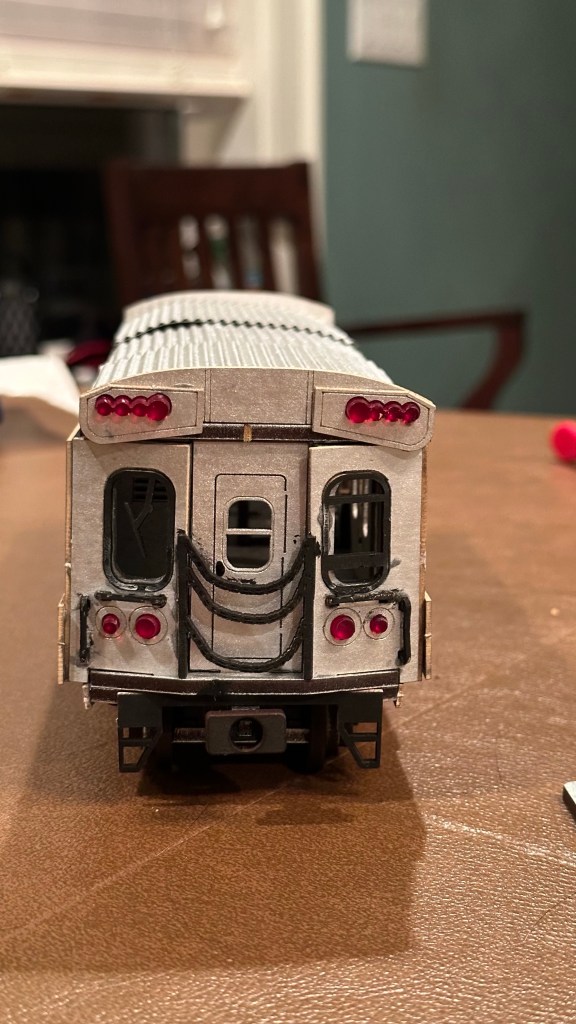
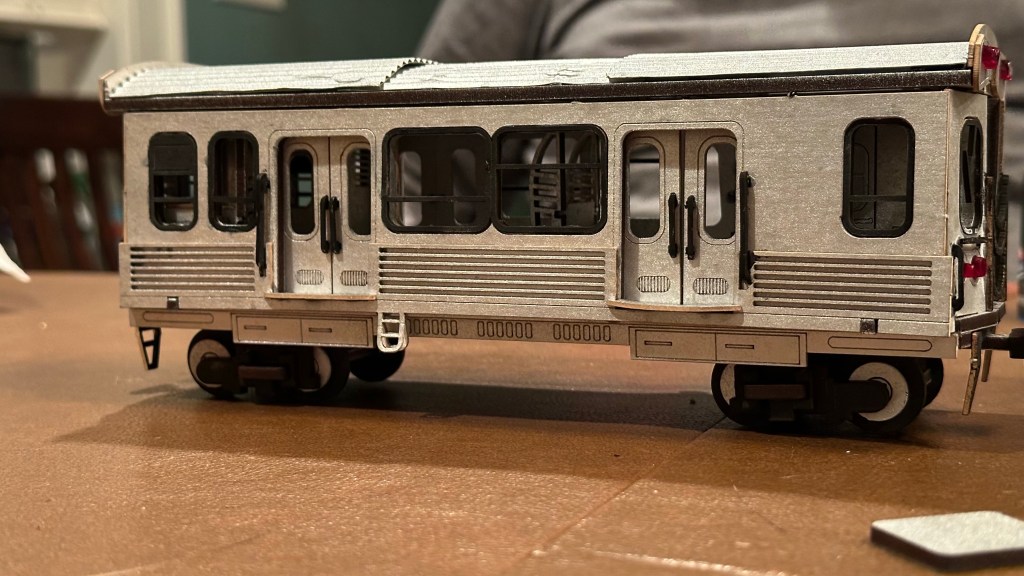
He has started collecting model subway cars to add to his already vast transit map collection. For his birthday, he asked for more models. He has traditionally wanted only completed models, but we thought we’d get him a kit and see if he’d enjoy building one. My husband has built model kits before (planes), so our sons have seen some of the joy this brings to their dad.
When our son opened the kit, we thought our chances were 50-50 that he’d want to build it, vs. having us send it back. I asked him if he’d like to work on it together and he said, “I’d like to work on this with dad because he’s done these things before.” I smiled—partially because he wanted to build it, and two, he wanted my husband’s help and not mine (I’m sure I could have helped him, but not sure I would have been the best partner). 😊
He and my husband set out working on the model subway car each night. Watching them work together on the build was something. There was excitement (for the model taking form), stress (oh no, we threw out the roof think it was trash, go check the recycling!), relief (thank goodness it wasn’t recycle pick-up week), and quiet love as they worked on the model figuring it out piece by piece. This model build may be the most special one for my son (and husband), since they built it together.
What have you and your child done together that’s been special and/or brought you closer?
Have you ever wondered what your child is thinking? How they see themselves? How they think others see them?
My youngest is willing to engage without much effort and comfortable sharing who he is with his father and I, and others. My oldest is more of a closed book—engaging infrequently and sharing bits and pieces that make it hard(er) to figure the complete picture out.
My oldest engages as he’s ready, late at night when my husband is getting ready for bed, in the car when I pick him up from practice, or what my husband and I feel are “out-of-the-blue” moments. My son recently asking his father if he wanted to go for a run with him. My husband had to suppress his excitement—and surprise at my son’s request (it’s that meaningful to us when he opens up to us and shares, well, anything).
His football team has had a good year and are now in the playoffs. He helps manage the team and does film review with the coaches. He seems more comfortable than I’ve seen him in a while. Before the most recent game, the officials were down on the field before the game started. My son, who also referees flag football games, seemed to know at least one of the officials through his other job. They shook hands, talked, laughed, and then the other officials came over. I saw my son talk easily and shake hands with the others. It was impressive to watch. If you didn’t know better, you would have thought my son was in a higher leadership position, such as the head coach. The moment gave me pause. “Who is this kid?” The confident young man on the field looked like my son, but wasn’t acting like the kid I know. I wondered what else I didn’t/don’t know about him.
As a parent, I long to know my children deeply. I want to know who they are, what motivates them, makes them happy, and what will help them thrive. I also want to know their father and I are doing right by them, and helping prepare them to navigate life so it’s meaningful and joyful, and ensure they have the tools to navigate tough times and situations and know they’ll make it through and be okay. Yet, I’m in the stands of the game wondering who my son is, how I can know him better, and make sure I’ve done my job.
I’m not sure if we ever truly know this as parents, which will have me always working towards knowing my children better.
How do you see your child? How have they shared who they are (or are becoming) with you?
Cool crisp air, leaves changing colors, apple cider. It’s definitely a favorite time of year for our family.
We went to a pumpkin patch that’s become a tradition for us. We arrive, take in surrounding area that has different decorative pumpkin, squash, and gourd displays; check out what the local vendors are offering, get a wheelbarrow and head out towards the fields to get our pumpkins. Once we have our pumpkins we typically head out to get a meal nearby before heading home. I take LOTS of pictures each time we go — trying to remember it all. 😊 My oldest reminded us that since this would be his last year doing this with us (gulp), he’d get to pick where we ate lunch following. 😂
The pumpkin patch looked different than previous years — fields had been rotated, the corn maze was gone (as the corn, in the new field, was only three feet tall), but it didn’t matter because we were there together. Making our way through the fields to find our pumpkins, enjoying cider, and just being with each other.
It wasn’t anything special per se, but was special because of the tradition and memories and the wonderful feelings that come with it.
I do love this time of year.
What Fall traditions does your family have?
‘It’s going to be okay’ is a phrase that has gotten me through many a difficult situation. Hearing from my parent, when I was young, or my husband now, has always given me comfort.
My oldest had a test that was stressing him out. He was struggling with some of the concepts being taught and was concerned he wouldn’t do well on the test. We talked about what he could do to prepare in advance. That helped ease his anxiety slightly but it was still there. He took the test, and the teacher had the students take pictures of their work which they emailed in. It was an additional step to handing in the test to a proctor. My son came home. He was relieved that the test had gone much better than expected, but stressed because he realized in his desire to leave the testing area as soon as possible after turning in the test, he realized he hadn’t gotten clear pictures of all of his work. “Mom, the pages that didn’t come through equal 20% of my grade.” He sat down, put his head in his hands and said, “how will I ever be able to live on my own?” That statement caught my attention. I can understand being stressed about a mistake you’ve made that might result in something negative happening to you (such as getting a poor grade), but thought him extrapolating this to not being able to go out on his own an extreme thought.
We talked about the situation at hand first. I asked him what he could do to rectify the situation. He shared he’d already emailed the teacher and we discussed him going back to the test site to see if the proctor would allow him to retake the pictures of his work (he went back, but the proctor wouldn’t allow him access to his test). I then shared my own experience and how sometimes in life I catch myself wanting to leave a situation (for discomfort, I want to get to the next thing, or a variety of other reasons) and I can make mistakes in those situations. I asked my son, “how am I able to keep going if I know I might do this? I’ve lived on my own for a while and I’ve never been concerned in my ability to successfully do that. Why is that?” I smiled and he did too. It didn’t take him long to come back with the correct answer, “you learned from your mistake.” I told him that he was right and shared that even though I still “do things fast” on occasion, I do them less frequently than when I was younger and I try to catch myself in the moment and tell myself to “slowdown”. I finished by telling him that no matter the outcome of the test everything was going to be okay. I told him, “it might not feel like it now, but I promise you everything will be okay.” A poor grade can be overcome with improved work and extra credit (assuming the teacher allows). Absolute worst case is he fails the class and has to take it over. While the scenarios might not seem fun, they were all something that could be addressed. Not long after we finished our conversation my son shared that he’d heard from his teacher who told him not to worry about it, he was more concerned with the work being shown on the test, than the actual pictures coming through and being clear. It had indeed ended up being okay.
How do you help your child work through a mistake they’ve made? How do you let them know things will work out or be okay?
At what age did you emerge from your childhood cocoon?
My oldest is a senior and thinking about where life will take him next. He’s starting to get a taste of having more freedom and understanding that he ultimately controls where and what he does next. While he’s still living at home, he has a safe, protected, and supportive environment to make mistakes and learn from them.
As I think about his upbringing I can see clear lines between him as a small child and the adult he is becoming. Then there is this gray period inbetween the two where he is leaving one phase of life and preparing for another. In this “cocoon”-phase he could be distant, and hard to understand, but you knew what was inside him needed to be protected and nourished and so you let the cocoon be — not leaving it alone, but understanding (or trying to) how growing up can be hard and scary sometimes. It can also be joyful and comforting, and so much more.
It feels like my oldest is starting to emerge from his cocoon with a more open disposition. He’s more likely to talk, engage, and is in general happier. Is it because he’s understanding he will figure out his next stage of life? He’s appreciating the love and support while making the transition? Or something else?
Only he knows, but it’s amazing to see this new phase and him taking flight.
What phase of life is your child in? How are you helping them transition from one phase to another?
Have you ever parted ways with a friend?
Parting has been easiest, for me, when our locations and situations took us different places and nothing was explicitly said. The door open to reconnect or resume the friendship is there should the opportunity arise. It’s hardest when betrayal or some type of perceived hurt has occurred — coming back from it might not be possible. Then there is everything in between.
My youngest in high school has reconnected with an elementary classmate, and together brought a third, newcomer, into their group. My son enjoyed getting to know his new friend, even walking home from school a few times together, until he didn’t. He started seeing differences between he and this new person which made him take an inventory for what he wants in a friendship. This new friend appreciates women based on looks more than anything else, and likes watching/listening to crude humor on his phone. I can’t say this is untypical of any teen, but what struck me was how off putting it was to my son. My son shared his friend had been vulnerable with him, and he was in turn, but then the friend started teasing him about what he opened up about, making him regret sharing at all. The final ‘blow’ was when the friend kept trying to get my son to engage with him during lunch period, and my son wanted no part. My son shared, “I don’t think I want you to be friends with him anymore.”
I’ve often felt my son wanted more friends, but what held him back was some challenges he faced by being on the spectrum (such as missing social cues), what I found was my son having clarity in what he wants in friendship and not being willing to settle.
We talked about the differences between he and his friend, with the main one being my son had had the good fortune of having teachers, and caregivers that modeled healthy relationships and strong emotional intelligence — give him tons of tools for his toolkit. His friend, hadn’t had these same resources and may not have the knowledge my son has. The comparison I made was my son have a full tool belt, uniform, and protective gear, and his friend being naked. I shared this with my son, so he would have empathy for his friend. He could either help his friend grow with his knowledge or part ways because the effort wasn’t worth it or the friend wouldn’t be open to it. My son took it under advisement and decided he wouldn’t proactively engage this friend, but wouldn’t outright tell him the friendship is over either. So far it’s worked out. Neither boy has really engaged the other and the loss of a friendship doesn’t seem to bother my son (or the other boy, best we can tell), at all.
Ending a friendship is never easy. Making a new friend isn’t easy either. How are you helping your child navigate friendship?
Who has been sucked into volunteering in support of your child’s school, sports, or activity?
I use the words ‘sucked in’ because most volunteer work I have been done has been based guilt (the other parents can’t always go everything, I’m being selfish if I don’t give freely of my time, etc.), vs. being passionate about the cause — the one exception was my youngest’s middle school that was a start-up and beyond unbelievable (like winning the golden ticket for my son’s education). I think of this as the parent trap. Any one else gotten sucked in?
I have had to re-establish boundaries periodically. Saying “no” when asked and allowing myself to sit with the guilt. It always feels good to volunteer and support others, but the time commitment (planning, night/weekend events, etc.), and stress of the planning and execution of the events are the detractors for me. Does the feeling afterwards of helping offset the stress leading up to? Most time the answer is “maybe,” yet I (you/we?) volunteer. I most recently made the mistake of showing up early to a showcase my son was participating in. A mom came over, introduced herself, shared how she led volunteer coordination (I knew the ask was coming, and braced myself for it). She then sat down (okay, I thought, she’s not going anywhere until I agree to something, I’m going to have to negotiate). I didn’t want to outright own a responsibility. I was okay co-chairing, but would prefer the work be split by three. We discussed and I reluctantly (darn you guilt) agreed.
I remind myself my youngest has three more years in high school, so volunteering in this capacity has a time limit. I may even miss it when these opportunities no longer present themselves (though I’m sure they’ll be replaced by others). If I’m being honest with myself, nah, I won’t miss it, I’ll be relieved. Am I the most selfish person ever? Ah, the guilt. It can feel like a never ending trap.
How do you view volunteering? How do you offset any guilt you feel?
Start your engines!
Picking and dropping off kids can feel like a never ending cycle. Leave work (or house), pick up kid, take to next place, return (or wait), then do it all over again. I thought with my oldest getting his license and youngest learning to drive, the endless cycle of coming and going might end, but my oldest uses my car, which I need for work and other commitments, and there are limited places to park at school, so parental driving continues.
Some days it can feel like I’ve just had a moment to ‘rest’ when I’m reminded it’s time to jump back in the car and do it all over again. After a particularly stressful day at work, I got one of these reminders in the form of a phone call from my son. We agreed on where to meet and I begrudgingly started out the door to pick him up. I slowed as I neared my car. My oldest will be on his own before too long, and I’ll likely miss the opportunity to drop him off and pick him up — it’s one of the few moments I have alone with him and (if I’m lucky) find out what’s on his mind, how his day was, or hear how he’s doing.
The route to drop my boys off has been different from preschool to elementary to middle and high school. The drives themselves grew old, but never the time together.
How many laps have you made taking your child to and from places? What will you miss most when you’re no longer doing it?