Feedback is Hard

How do you get feedback?

Feedback can be hard to give and get. My youngest tried out for the school Spring musical in early December. He thought he did well, or better than years past, and thought he had a good chance of getting a speaking role. The cast list came out the Friday afternoon before winter break. The teachers were clear, no one comes to them once the list is posted with questions, the student can schedule time during feedback sessions that will happen once school is back in session.

The list came out. My son was anxious — nerves and excitement. Unfortunately, he didn’t get a speaking part. He was cast in the ensemble. He was devastated. He broke down and talked about his disappointment—the work and practice he’d put in, how much he’d wanted a speaking part, and how bad it hurt. As a parent, it was hard to witness, but I tried to give him space to experience his emotions and reassure him he’d be okay. I did encourage him to take the teachers up on their offer to provide feedback. He didn’t want to even think about it, at first. The hurt was too fresh and hearing any criticism, even constructive, would be too tough.

I encouraged him to get time with the teachers again over break, for no other reason than to know clearly why he didn’t get a speaking role. Was it skill? Meaning he didn’t sing or dance well enough? Or was his acting not a match? Or something else? If he knew he’d know what he needed to work on vs. guessing and not giving himself the best chance in future auditions. I told him getting constructive criticism is a gift — the intent is to help you get (or be) better. My son listened, but still wasn’t convinced. It helped that his grandfather also encouraged him to get feedback and the value in hearing it even if it’s hard. My son now had to decide for himself.

When school resumed I asked my son what he was going to do. “I already signed up to get feedback,” he said, “I’m worried they’ll tell me I’m not good at something, but hoping they’ll just say it wasn’t my year.” The musical the school will be performing does have a small cast. I was glad he was going to get the feedback even though it wasn’t easy.

After getting the feedback, he came home and shared what they told him, it was a mix of some things he could do to improve on (work on parts of his stage presence), and with so few roles, he just was a little short of getting a speaking part. He was at peace with the feedback and I was really proud of him for doing it.

Getting feedback is hard. What’s the most helpful feedback you’ve ever gotten? How are you helping your child be more open to receiving feedback?

I’ll be off again next week for the long weekend and back later this month.

Neighborhood (Pet) Watch

What are you on the lookout for in your neighborhood?

We take evening walks when the weather is nice in our neighborhood. A favorite pastime during these walks is to find neighborhood cats. Finding a new one is even better.

My husband texted me during a walk he and my son were on, and asked if I’d prepare a bag of cat food for him. They had found a new cat that was skin and bones and they wanted to feed it. They did, and came back sharing news about the cat they found and the concern it had a home. My youngest made it his mission each day after to go back to that part of the neighborhood to find the cat again. While it had a flea collar on (indicating it had a pet parent), its size had us concerned. Maybe the pet parent had fallen ill, or could no longer afford to feed the animal.

My son turned detective and became relentless at solving the case. If the cat had owners, they needed to take better care of the cat. If the cat was lost, he wanted to reunite it with it’s pet parent (though I have a sneaking suspicion he would have been okay if no parents could be located and he could adopt the cat). 🥰 He knocked on doors (no one answered). He talked to a nearby neighbor out in their yard. He even called the local vet and animal rescue to get advice from them on what he should do. It was a growing experience for him. Engaging with neighbors in this way, and making phone calls to inquire about the animal were new to him.

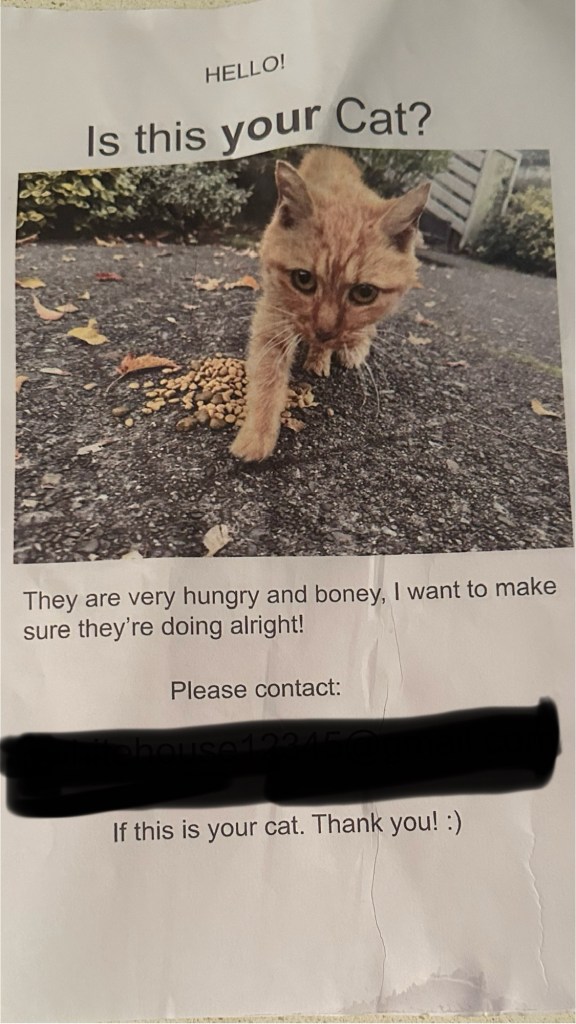
At the encouragement of his father he made a sign to hang in the neighborhood near where he’d seen the cat.

Sign for Neighborhood Cat

I didn’t see the poster before he left the house armed with food, water, bowls, the poster and a stapler. He was going to make sure this cat was cared for. I did see it once he was back, reporting the cat did have a pet parent, and he saw the cat eating from a bowl outside. You could tell it was bittersweet for him — happy the cat was being cared for after all, but sad he couldn’t be the one to do it.

I suspect we’ll continue our walks and check in on this cat each time we’re out (for the foreseeable future). It’s good to keep an eye on those that are vulnerable and do whatever it takes to get them help. I’m proud of my son for his commitment to this cat’s well-being.

What do you keep an eye out for in your neighborhood?

Weathering the Storm

Watching the destructive weather that has hit the southeast these past few weeks has been hard to take it. On one hand, you’re grateful you’re not in the path of the destruction, but scared, sad, and empathetic to those experiencing it, particularly when many of the people are family and friends (or remind you of your family and friends).

There wasn’t much we could do as Milton barreled towards Tampa. We had family recouping from major surgery (that couldn’t evacuate) in the area, and many loved ones scattered north, south, and east. No one seemed to be truly safe. Throw in the tornadoes that occurred relatively ‘far’ away from the center of the storm, high winds, and storm surge, and taking it all in from afar felt almost unbearable.

There were calls, and texts, before and after the storm. Grateful when you learned someone was safe, nerves when you haven’t. After I had reached out to immediate family, my youngest asked who else I’d checked on. “Mom, we have to make sure everyone is okay.” I appreciated his genuine concern, and him reminding me to continue reaching out, even though electricity, connectivity, and accessibility (coming to and from where you have access to these things), are not available for many and likely won’t be for some time. Waiting to hear is hard.

I think about those that have lost their home, or possessions, or a loved one. I think about schools being closed, how these traumatic events affect adults and children — it changes you. Seeing everyone pitching in regardless their socioeconomic status, or political leaning, or religious affiliation, come together to help on another, makes me hopeful for how we weather these storms. Community — us coming together—is your family during these times.

What storms (literal or figurative) have you and your family weathered?

Losing Control

What do you want to have control over?

I might answer, “Everything?” The question mark is on purpose…having control of everything, in theory, sounds ideal, but could also quickly become overwhelming and problematic.

My youngest’s play will be performed on stage in the upcoming weeks. While he is beyond excited his work was picked, anxiety has crept in. Other students are producing the play and he hasn’t been asked for any input. While he was able to produce a snippet in the Spring playwright show, it was limited in showing his full intention for how the play should be preformed. The students producing the play have creative liberty to interpret and make the show as they see fit, with the characters and lines remaining as my son wrote them.

My youngest has extended his desire to help the producers as they work on his show, but they haven’t taken him up on it. Two things are causing his angst — being on the spectrum he wants things a certain way (don’t we all?) and fears too much of the play details are in his head (vs on paper), and he has essentially lost creative control of his baby. You pour your heart and soul into something — a book, music, or a play! — and someone might see it through a different lens than you, and not perform it the way you intended (content serious, not funny, music fast, not slow, etc.). There really isn’t anything he can do about this.

My son asked my husband and I for advice. “No one has reached out to me for my input on the show. Should I ask them again? Or maybe I should just drop by when they’re practicing?” We responded with a resounding, “No!” We talked to him about his concerns and how he doesn’t have control and how uncomfortable it can be, but he needs to trust his peers will do their best. He heard us, but having a hard time letting go of the idea he’ll have more influence or say in what gets performed. We also discussed what he might take away from this — can he be more detailed in his notes and stage direction, or anything else to lessen his concern in the future?

Losing control is almost always unsettling. It can leave you feeling untethered which can be scary, frustrating, and more. How do you or your child handle times when you don’t have control?

Having Your Passion Acknowledged

My youngest has always had a creative side to him. When he was younger, he’d sit in his room and write, and write, and write. When he shared what he was working on, he’d essentially written several TV episodes, a season or twos worth. It was a story line he had in his head that he just had to get out on paper.

While very impressive, when I tried reading the dialogue and tried to understand what was going on, it was hard to follow. I told this to me son (gently), and he understood saying what connected things (stage direction, narration, cues) was in this head.

He has been in theatre for the past several years. His school has a well respected program that teaches students not only to act, but do set production, tech crew, be a playwright, producer, and more. They really help prepare all students interested in pursuing this field.

He took a play writing course in the Spring. He and his peers submitted their plays, which included stage direction, narration, and acting cues that he’d previously left out (or been unaware of how to integrate into his TV episodes years earlier). All submissions (approx. 16) were handed in and then a brief segment acted out from each during a playwright’s workshop. They announced at the workshop they’d select around half the shows to be performed (in full) in the Fall showcase. My son was excited to submit his play, see part of it acted out then, with hopes of having his script being selected and the entire play come to life in the Fall show.

The beginning of school brought new hope and anxiety for my youngest — a new grade with harder classes, and waiting to see if his script was picked for the Fall show. Thankfully within the first two weeks of school they made the announcement. I was anxiously awaiting his arrival home the day he would find out. “Well, did your show get picked?,” I asked. He acted disappointed, and while I’d prepared for this scenario, there was something about his body language that clued me into him trying to trick me into thinking it hadn’t, when it had. “Your play got picked didn’t it?” I said. After a pause and one last attempt to make a sad face, his mouth broke into a wide smile. “Yes! They announced my play last! I was sure I wasn’t going to get picked.” He beamed. You could see how much this meant to him. It validated his passion, and his work (and the love he’d put into it). This acknowledgment made my son practically burst with pride and his capabilities. I couldn’t have been prouder, or happier for him.

He has been walking on air a bit since the announcement. It’s been a confidence boost to him. He now is starting to think like a director, producer, and playwright — wanting to work with the director (a fellow student (as no playwright directs their own show) — to ensure his vision for the show is realized. I’m excited for him.

It’s not often in life we get positive reinforcement doing the things we love. The acknowledgment is helping my son come into his own — realizing he does have talents (beyond what mom, dad, and close family and friends tell him). It’s a gift when this happens. Rare and wonderful.

What is your child’s passion? How has it been acknowledged?

Who Are You?

Have you ever wondered what your child is thinking? How they see themselves? How they think others see them?

My youngest is willing to engage without much effort and comfortable sharing who he is with his father and I, and others. My oldest is more of a closed book—engaging infrequently and sharing bits and pieces that make it hard(er) to figure the complete picture out.

My oldest engages as he’s ready, late at night when my husband is getting ready for bed, in the car when I pick him up from practice, or what my husband and I feel are “out-of-the-blue” moments. My son recently asking his father if he wanted to go for a run with him. My husband had to suppress his excitement—and surprise at my son’s request (it’s that meaningful to us when he opens up to us and shares, well, anything).

His football team has had a good year and are now in the playoffs. He helps manage the team and does film review with the coaches. He seems more comfortable than I’ve seen him in a while. Before the most recent game, the officials were down on the field before the game started. My son, who also referees flag football games, seemed to know at least one of the officials through his other job. They shook hands, talked, laughed, and then the other officials came over. I saw my son talk easily and shake hands with the others. It was impressive to watch. If you didn’t know better, you would have thought my son was in a higher leadership position, such as the head coach. The moment gave me pause. “Who is this kid?” The confident young man on the field looked like my son, but wasn’t acting like the kid I know. I wondered what else I didn’t/don’t know about him.

As a parent, I long to know my children deeply. I want to know who they are, what motivates them, makes them happy, and what will help them thrive. I also want to know their father and I are doing right by them, and helping prepare them to navigate life so it’s meaningful and joyful, and ensure they have the tools to navigate tough times and situations and know they’ll make it through and be okay. Yet, I’m in the stands of the game wondering who my son is, how I can know him better, and make sure I’ve done my job.

I’m not sure if we ever truly know this as parents, which will have me always working towards knowing my children better.

How do you see your child? How have they shared who they are (or are becoming) with you?

Growth Spurt

My youngest is trying out for a part in a school play. He went through tryouts early his freshman year, and his experience was much different. His freshman year, everything was new—people, process, and place (he was still figuring out where things were in the school building). It was overwhelming and made him flustered. He overcame being upset when he struggled with the audition process with the help of patient teachers and time to calm himself down. We talked with him about what he’d learned after he had settled down and the audition was behind him, and what he’d do differently in future new situations.

Fast forward to this school year. Tryouts again, but nothing new, with the exception of a few new faces (younger or new students). He was confident, and excited. A dramatic (pun intended 😁) improvement from his freshman year. We talked about what was different, how he’d grown since his freshman experience, and how he’d survived—maybe a strong word, but it helped him understand he could weather new (tough, uncomfortable, unfamiliar, etc.) situations, He had grown based on his initial experience. It was a steep learning curve for him, but a needed one.

As he shared more details on how the tryouts went with his father and I we talked about this, and how when you’re young and go through steep learning curves it can feel overwhelming and scary, but they often level out, and you work towards the next big learning experience but normally have time to build up that next it (getting a job, going to college or trade school, living on your own, etc.). You could see him realize he had it in his to rise to whatever that next challenge may be, and that he had time to grow to it.

What growth spurt is (or has) your kid going through?

Impossible

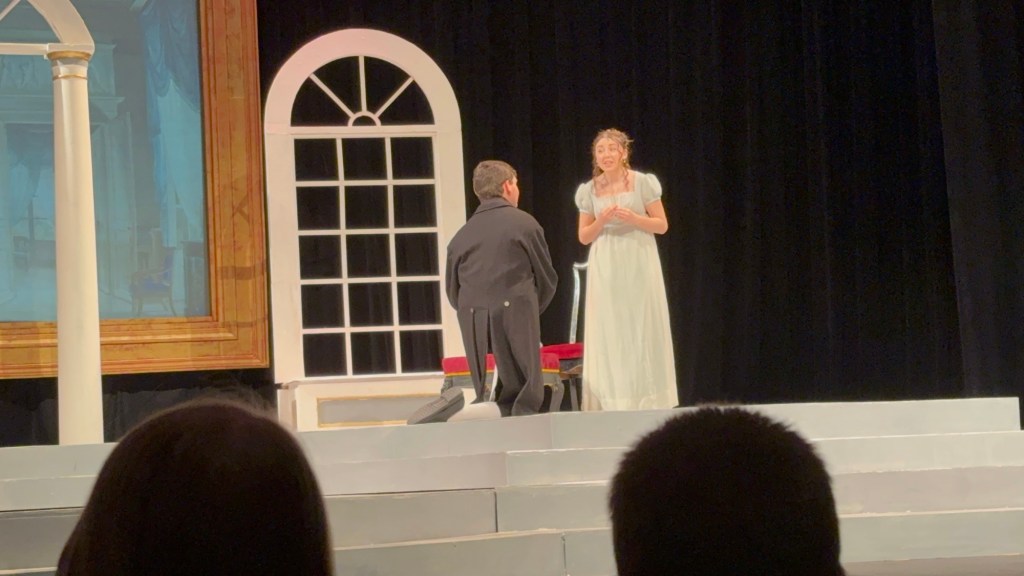
My youngest is doing theatre in high school. The school has a reputation for putting on Broadway quality shows. It was amazing when he got a part in the Spring Musical as a freshman (only five others, of a cast of 65, joined him).

In elementary school, he enjoyed theatre practice. In high school, he’s found it’s more serious, takes more time, and the stakes are higher (some kids are hoping to make a career with their abilities). Sometimes he’s found what was being asked of him impossible. My son hasn’t enjoyed theatre most of the year because of the intensity of it all – learning dance routines, songs, choreography, and more. While we told him he was committed to seeing the musical through, he voiced doubts about wanting to continue beyond this year (sad for his father and I because he’s pretty good at theatre and has been the one school activity he’s been willing to participate in).

The play, Cinderella, opened last week. Even though we had the hiking scare and he sprained his ankle, the brace he wore allowed him to perform. With each performance his enjoyment of theatre has returned. Unsure if he’s enjoying the fruits of his labor — seeing that he learned all the dances, songs, movement, or the audiences response is getting him to change his view — with tons of applause throughout the show because the performance, stage design, tech crew, and orchestra are just that good. The best part, he’s interested in continuing theatre beyond this year.

A song in the play is titled, “Impossible”, and it seems fitting for my son…thinking something is impossible only to figure out it’s possible after all. 😊

What has your child figured out is possible?